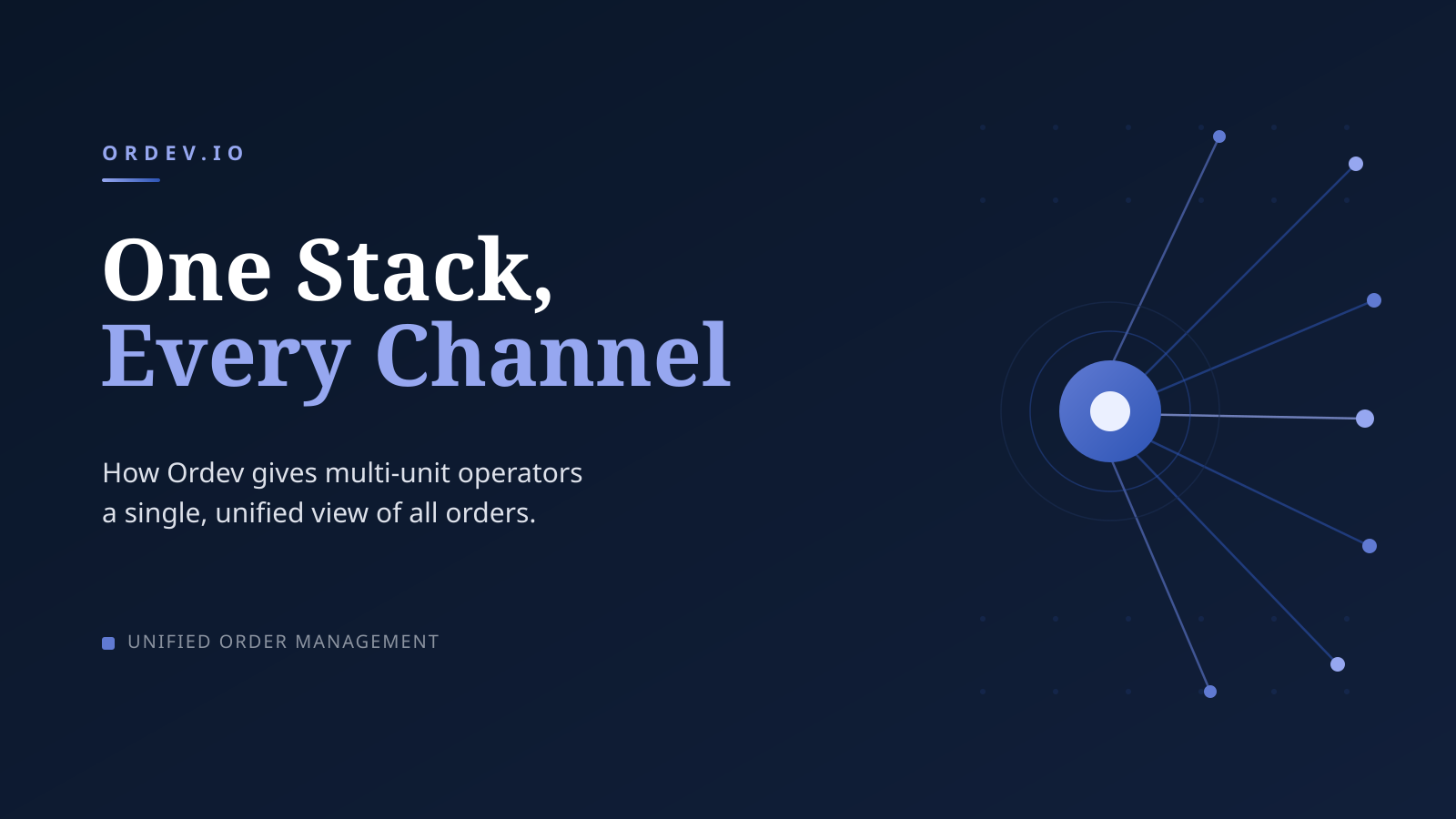
One Stack, Every Channel: How Ordev Gives Multi-Unit Operators a Single View of All Orders
Running five restaurants is not five times harder than running one. It is exponentially harder, unless your technology consolidates every channel into a single, coherent picture. That is exactly what Ordev is built to do.
Multi-unit operators lose money in the gaps between systems. A customer ordering online through your website, another placing a WhatsApp order, and a third tapping through a self-service kiosk at the counter — these are three revenue streams that most platforms treat as three separate problems. Ordev treats them as one.
The Real Cost of Fragmented Order Management
Fragmentation is not just an operational inconvenience. It is a revenue leak. When your team reconciles orders from four different dashboards at the end of a shift, you pay in labour, in errors, and in the delayed decisions that come from never seeing a clean, consolidated number.
Multi-unit operators need to know, in real time, which sites are performing, which channels are driving volume, and where fulfilment is breaking down. That intelligence is impossible when your ordering online data lives in one system, your kiosk transactions in another, and your WhatsApp ordering logs in a spreadsheet someone updates manually.
Ordev eliminates that fragmentation by design.
What a Single View Actually Means
A single view is not a reporting dashboard bolted onto disconnected tools. It is a unified data layer where every order — regardless of channel, site, or time of day — lands in the same place, in the same format, with the same structure.
With Ordev, an operator managing ten locations across Johannesburg and Cape Town sees all inbound orders on one screen. Orders placed through online ordering on the website, through WhatsApp ordering initiated by a customer message, and through self service kiosk software at any counter all flow into the same pipeline. The kitchen sees a unified queue. Management sees a unified revenue figure. Finance sees a unified audit trail.
That is control.
How Each Channel Connects
Ordering Online
Ordev's online ordering infrastructure is built for operators who want their own branded channel — not a third-party marketplace that owns the customer relationship and clips the ticket on every transaction. Your menu, your pricing, your data. Orders come through and route directly to the correct site based on customer location or selection. No manual forwarding. No copy-paste into a POS.
WhatsApp Ordering
WhatsApp ordering is where operators are winning customers that web-based channels miss. South African consumers are comfortable transacting on WhatsApp — the friction of downloading an app or navigating a mobile website disappears. Ordev's WhatsApp ordering integration captures those orders, structures them against your menu, and pushes them into the same fulfilment pipeline as every other channel. There is no separate workflow for your staff to manage.
Self Service Kiosk Software
In-store volume is still significant, and self service kiosk software handles it without adding headcount. Ordev's kiosk layer runs on standard hardware and connects to the same menu management system that drives your online and WhatsApp channels. Change a price once — it updates everywhere. Add a limited-time item — it appears on every kiosk at every site simultaneously. The self service kiosk software also captures upsell prompts consistently, which a counter assistant under pressure during a lunch rush will not.
A Practical Example
Consider a quick-service operator running eight sites across Gauteng. Before consolidating onto Ordev, they were managing a third-party online ordering platform, a manual WhatsApp process handled differently at each site, and kiosk software from a separate vendor that did not talk to anything else. End-of-day reconciliation took forty-five minutes per site. Menu updates required logging into three systems. Pricing errors at the kiosk were only caught when a customer complained.
After moving to Ordev, all eight sites run on one stack. Online ordering, WhatsApp ordering, and the self service kiosk software all pull from a single menu source. The operator's head of operations checks one dashboard each morning — order volume by channel, by site, by hour. Menu changes push from one admin interface. Reconciliation is automated. The forty-five-minute daily task per site no longer exists.
That is not a feature story. That is forty-five minutes multiplied by eight sites multiplied by every trading day — recovered and redeployed.
Built for Operators Who Scale
Ordev is structured for operators who are adding sites, not managing a single location. The platform's architecture means that onboarding a new site is a configuration exercise, not an integration project. Your existing menu, pricing rules, and channel connections extend to the new location without rebuilding anything.
For technical teams, Ordev exposes a clean API layer that connects to existing ERP, loyalty, and inventory systems. You are not locked into a closed ecosystem. If you have a loyalty programme that already knows your customers, Ordev connects to it. If your inventory system needs order data to trigger stock alerts, the API delivers it.
Multi-unit operators have real IT infrastructure. Ordev respects that and integrates with it rather than asking you to replace it.
Revenue Visibility Drives Better Decisions
The most direct benefit of a unified order view is decision speed. When you can see that WhatsApp ordering at your Sandton site is outperforming the equivalent channel at your Rosebank site by thirty percent, you ask why. You look at response times, menu availability, and customer feedback. You act on it within a day rather than discovering it three weeks later in a monthly report.
When your self service kiosk software shows that a specific upsell prompt is converting at double the rate of others, you roll that prompt to every site immediately. When online ordering drops at a site on a specific day, you investigate before the pattern costs you a full week of revenue.
That is the commercial value of a single view — not the technology itself, but what it lets you do with information while it is still actionable.
Get Every Channel Working Together
If you are operating multiple sites and still managing orders across disconnected platforms, the cost is real — in labour, errors, and missed revenue intelligence. Ordev puts online ordering, WhatsApp ordering, and self service kiosk software under one roof, giving your operation the visibility and control it needs to grow without growing complexity. Speak to the Ordev team at ordev.io to see how the platform connects your channels and consolidates your order view from day one.